| Safe Haskell | None |
|---|---|
| Language | GHC2024 |
Proarrow.Optics
Description
The user-facing optics vocabulary, in one import.
- Build optics with
iso,lens,monLens,prism,affineTraversal,grate,glass,powerGrate,cotraversal,kaleidoscope,algebraicLens,classifyingLens,tracer,traversed,traversal(aTraversalfrom its van-Laarhoven / profunctor-class form),toandunto. These produceProstrong-flavored optics (Iso,Lens,Prism,Traversal, ...), which support subtyping: any optic can be used directly wherever a weaker flavor is needed (aLensis aGetter, aSetter, aFold, ...), checked by the flavor superclass lattice.MonoidalTraversalis built from its van-Laarhoven form withfromPTraversal. Only the three read-/write-only flavors (Setter,Fold,AffineFold) have no builder of their own -- reach them byconvertfrom a stronger optic (or%-composition, asaffineTraversaldoes with aLensand aPrism). - Eliminate optics with exactly one canonical eliminator per flavor:
view(aGetter),review(aReview),preview(anAffineFold),matching(anAffineTraversal),over(aSetter),foldMapOf(aFold),traverseOf(aTraversal),monTraverseOf(aMonoidalTraversal),powerGrateOf(aPowerGrate),cotraverseOf(aCotraversal),kaleidoscopeOfandzipWithOf(aKaleidoscope),classifyOf(anAlgebraicLens) andtracerOf(aTracer) run the optic, whilewithIso,withLens,withMonLens,withPrism,withGrateandwithGlassrecover its two legs. Operator shorthands ((^.),(#),(^?),set,(%~),(.~),unfold) abbreviate the common ones. All of these are encoding-agnostic. - The library's structural isos (e.g.
associator) live in a second, profunctor-class-flavored encoding (PIso); every consumer above accepts those as-is too, so this distinction rarely matters. When it does — converting between the encodings, van Laarhoven interop, writing flavor-generic code — import Proarrow.Optic and its submodules directly.
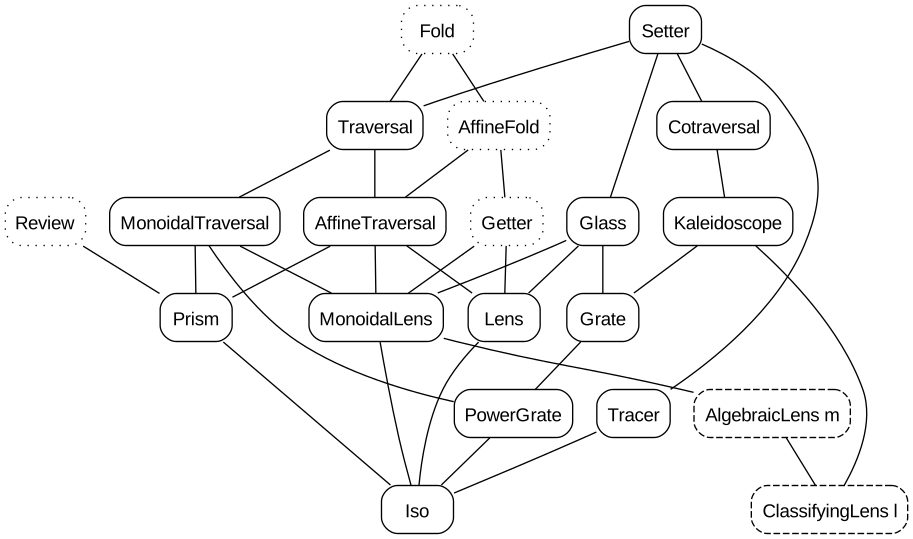
The full subtyping lattice (flavor superclass edges, weakest optics at the top).
Dotted nodes are one-sided flavors, whose methods never mention the second witness; dashed
nodes are indexed by a monad and so have no edge to Iso:
Synopsis
- type Optic (c :: (j +-> k) -> Constraint) (s :: k) (t :: j) (a :: k) (b :: j) = Optic_ ('OPT a b :: OPTIC j k c) ('OPT s t :: OPTIC j k c)
- type Optic' (c :: (j +-> j) -> Constraint) (s :: j) (a :: j) = Optic c s s a a
- type Iso (s :: k) (t :: k) (a :: k) (b :: k) = Optic (Prostrong (IsoFl :: (k +-> k) -> (k +-> k) -> Constraint)) s t a b
- type Iso' (s :: k) (a :: k) = Iso s s a a
- type Lens (s :: k) (t :: k) (a :: k) (b :: k) = Optic (Prostrong (LensFl :: (k +-> k) -> (k +-> k) -> Constraint)) s t a b
- type Lens' (s :: k) (a :: k) = Lens s s a a
- type MonoidalLens (s :: k) (t :: k) (a :: k) (b :: k) = Optic (Prostrong (MonLensFl :: (k +-> k) -> (k +-> k) -> Constraint)) s t a b
- type MonoidalLens' (s :: k) (a :: k) = MonoidalLens s s a a
- type Prism (s :: k) (t :: k) (a :: k) (b :: k) = Optic (Prostrong (PrismFl :: (k +-> k) -> (k +-> k) -> Constraint)) s t a b
- type Prism' (s :: k) (a :: k) = Prism s s a a
- type AffineTraversal (s :: k) (t :: k) (a :: k) (b :: k) = Optic (Prostrong (AffineTravFl :: (k +-> k) -> (k +-> k) -> Constraint)) s t a b
- type AffineTraversal' (s :: k) (a :: k) = AffineTraversal s s a a
- type Traversal (s :: k) (t :: k) (a :: k) (b :: k) = Optic (Prostrong (TravFl :: (k +-> k) -> (k +-> k) -> Constraint)) s t a b
- type Traversal' (s :: k) (a :: k) = Traversal s s a a
- type MonoidalTraversal (s :: k) (t :: k) (a :: k) (b :: k) = Optic (Prostrong (MonTravFl :: (k +-> k) -> (k +-> k) -> Constraint)) s t a b
- type MonoidalTraversal' (s :: k) (a :: k) = MonoidalTraversal s s a a
- type PTraversal (s :: j) (t :: j) (a :: j) (b :: j) = Optic (StrongDistributiveProfunctor :: (j +-> j) -> Constraint) s t a b
- type PTraversal' (s :: j) (a :: j) = PTraversal s s a a
- type PTraversalFull (s :: j) (t :: j) (a :: j) (b :: j) = Optic ((StrongDistributiveProfunctor :: (j +-> j) -> Constraint) :&&: Strong (ProdAction :: j -> (PROD j, j) -> Type)) s t a b
- type Setter (s :: k) (t :: k) (a :: k) (b :: k) = Optic (Prostrong (SetterFl :: (k +-> k) -> (k +-> k) -> Constraint)) s t a b
- type Setter' (s :: k) (a :: k) = Setter s s a a
- type Getter (s :: k) (t :: j) (a :: k) (b :: j) = Optic (Prostrong (GetterFl :: (k +-> k) -> (j +-> j) -> Constraint)) s t a b
- type Review (s :: k) (t :: j) (a :: k) (b :: j) = Optic (Prostrong (Flip (GetterFl :: (j +-> j) -> (k +-> k) -> Constraint))) s t a b
- type AffineFold (s :: k) (t :: j) (a :: k) (b :: j) = Optic (Prostrong (AffineFoldFl :: (k +-> k) -> (j +-> j) -> Constraint)) s t a b
- type Fold (s :: k) (t :: j) (a :: k) (b :: j) = Optic (Prostrong (FoldFl :: (k +-> k) -> (j +-> j) -> Constraint)) s t a b
- type Grate (s :: k) (t :: k) (a :: k) (b :: k) = Optic (Prostrong (GrateFl :: (k +-> k) -> (k +-> k) -> Constraint)) s t a b
- type Grate' (s :: k) (a :: k) = Grate s s a a
- type Glass (s :: k) (t :: k) (a :: k) (b :: k) = Optic (Prostrong (GlassFl :: (k +-> k) -> (k +-> k) -> Constraint)) s t a b
- type Glass' (s :: k) (a :: k) = Glass s s a a
- type PowerGrate (s :: k) (t :: k) (a :: k) (b :: k) = Optic (Prostrong (PowerGrateFl :: (k +-> k) -> (k +-> k) -> Constraint)) s t a b
- type PowerGrate' (s :: k) (a :: k) = PowerGrate s s a a
- type Cotraversal (s :: k) (t :: k) (a :: k) (b :: k) = Optic (Prostrong (CotravFl :: (k +-> k) -> (k +-> k) -> Constraint)) s t a b
- type Cotraversal' (s :: k) (a :: k) = Cotraversal s s a a
- type Kaleidoscope (s :: k) (t :: k) (a :: k) (b :: k) = Optic (Prostrong (KaleidoFl :: (k +-> k) -> (k +-> k) -> Constraint)) s t a b
- type Kaleidoscope' (s :: k) (a :: k) = Kaleidoscope s s a a
- type AlgebraicLens (m :: k +-> k) (s :: k) (t :: k) (a :: k) (b :: k) = Optic (Prostrong (AlgLensFl m)) s t a b
- type ClassifyingLens (l :: k +-> k) (s :: k) (t :: k) (a :: k) (b :: k) = Optic (Prostrong (ClassifyFl l)) s t a b
- type Tracer (s :: k) (t :: k) (a :: k) (b :: k) = Optic (Prostrong (TracerFl :: (k +-> k) -> (k +-> k) -> Constraint)) s t a b
- type Tracer' (s :: k) (a :: k) = Tracer s s a a
- iso :: forall {j} {k} (c :: (j +-> k) -> Constraint) (s :: k) (t :: j) (a :: k) (b :: j). (CategoryOf j, CategoryOf k) => (s ~> a) -> (b ~> t) -> Optic c s t a b
- lens :: forall {k} (s :: k) (t :: k) (a :: k) (b :: k). (HasBinaryProducts k, Ob b) => (s ~> a) -> ((s && b) ~> t) -> Lens s t a b
- monLens :: forall {k} (m :: k) (s :: k) (t :: k) (a :: k) (b :: k). (Comonoid m, Ob a, Ob b) => (s ~> (m ** a)) -> ((m ** b) ~> t) -> MonoidalLens s t a b
- prism :: forall {k} (s :: k) (t :: k) (a :: k) (b :: k). (CopyDiscard k, HasCoproducts k, Ob a) => (b ~> t) -> (s ~> (t || a)) -> Prism s t a b
- affineTraversal :: forall {k} (s :: k) (t :: k) (x :: k) (y :: k) (a :: k) (b :: k). CategoryOf k => Lens s t x y -> Prism x y a b -> AffineTraversal s t a b
- grate :: forall {k} (s :: k) (t :: k) (a :: k) (b :: k). (Closed k, SymMonoidal k, HasCoproducts k, Comonoid (s ~~> a), Ob s, Ob a, Ob b) => (((s ~~> a) ~~> b) ~> t) -> Grate s t a b
- glass :: forall {k} (s :: k) (t :: k) (a :: k) (b :: k). (CCC k, Ob s, Ob a, Ob b) => ((s && ((s ~~> a) ~~> b)) ~> t) -> Glass s t a b
- powerGrate :: forall {k} (n :: Nat) (s :: k) (t :: k) (a :: k) (b :: k). (CopyDiscard k, HasCoproducts k, KnownNat n, Ob a, Ob b) => (s ~> Tensor n a) -> (Tensor n b ~> t) -> PowerGrate s t a b
- cotraversal :: forall {k} (p :: k +-> k) (s :: k) (t :: k) (a :: k) (b :: k). (Representable p, StrongDistributiveProfunctor p, Ob a, Ob b) => (s ~> (p % a)) -> ((p % b) ~> t) -> Cotraversal s t a b
- kaleidoscope :: forall {k} (p :: k +-> k) (s :: k) (t :: k) (a :: k) (b :: k). (Representable p, StrongDistributiveProfunctor p, Ob a, Ob b) => (s ~> (p % a)) -> ((p % b) ~> t) -> Kaleidoscope s t a b
- algebraicLens :: forall {k} (m :: k +-> k) (s :: k) (t :: k) (a :: k) (b :: k). (Algebra m (m % s), Comonoid (m % s), Comonoid s, OplaxMonoidalRep m, Ob a, Ob b) => (s ~> a) -> (((m % s) ** b) ~> t) -> AlgebraicLens m s t a b
- classifyingLens :: forall {k} (l :: k +-> k) (s :: k) (t :: k) (a :: k) (b :: k). (Algebra l (l % s), Monoid (l % s), Comonoid (l % s), Comonoid s, OplaxMonoidalRep l, SymMonoidal k, HasCoproducts k, Ob a, Ob b) => (s ~> a) -> (((l % s) ** b) ~> t) -> ClassifyingLens l s t a b
- tracer :: forall {k} (m :: k) (s :: k) (t :: k) (a :: k) (b :: k). (TracedMonoidal k, Ob m, Ob s, Ob t, Ob a, Ob b) => ((m ** s) ~> a) -> (b ~> (m ** t)) -> Tracer s t a b
- traversed :: forall {k} (t :: k +-> k) (a :: k) (b :: k). (Bicartesian k, Traversable t, Representable t, Ob a, Ob b) => Traversal (t % a) (t % b) a b
- traversal :: forall {k} (s :: k) (t :: k) (a :: k) (b :: k). (Distributive k, CopyDiscard k, SymMonoidal k, HasProducts k, Ob a, Ob b, Ob s, Ob t) => (forall (r :: k +-> k). (StrongDistributiveProfunctor r, Strong (ProdAction :: k -> (PROD k, k) -> Type) r) => r a b -> r s t) -> Traversal s t a b
- to :: forall {k} {j} (s :: k) (t :: j) (a :: k) (b :: j). (CategoryOf k, CategoryOf j, Ob b, Ob t) => (s ~> a) -> Getter s t a b
- unto :: forall {k} {j} (s :: k) (t :: j) (a :: k) (b :: j). (CategoryOf k, CategoryOf j, Ob s, Ob a) => (b ~> t) -> Review s t a b
- re :: forall {j} {k} (a :: j) (b :: k) (c :: (k +-> j) -> Constraint) (coc :: (j +-> k) -> Constraint) (s :: j) (t :: k). (Ob a, Ob b, ReversibleOptic c coc) => Optic c s t a b -> Optic coc b a t s
- view :: forall {j} {k} (c :: (k -> j -> Type) -> Constraint) (s :: k) (t :: j) (a :: k) (b :: j). (CategoryOf j, CategoryOf k, (Ob a, Ob b) => c (ExOptic (GetterFl :: (k +-> k) -> (j +-> j) -> Constraint) a b)) => Optic c s t a b -> s ~> a
- review :: forall {j} {k} (c :: (k -> j -> Type) -> Constraint) (s :: k) (t :: j) (a :: k) (b :: j). (CategoryOf j, CategoryOf k, (Ob a, Ob b) => c (ExOptic (Flip (GetterFl :: (j +-> j) -> (k +-> k) -> Constraint)) a b)) => Optic c s t a b -> b ~> t
- preview :: forall {j} {k} (c :: (k -> j -> Type) -> Constraint) (s :: k) (t :: j) (a :: k) (b :: j). (Bicartesian k, CategoryOf j, (Ob a, Ob b) => c (ExOptic (AffineFoldFl :: (k +-> k) -> (j +-> j) -> Constraint) a b)) => Optic c s t a b -> s ~> (a || (TerminalObject :: k))
- matching :: forall {k} (c :: (k -> k -> Type) -> Constraint) (s :: k) (t :: k) (a :: k) (b :: k). (Bicartesian k, (Ob a, Ob b) => c (ExOptic (AffineTravFl :: (k +-> k) -> (k +-> k) -> Constraint) a b)) => Optic c s t a b -> s ~> (t || a)
- over :: forall {k} (c :: (k -> k -> Type) -> Constraint) (s :: k) (t :: k) (a :: k) (b :: k). (CategoryOf k, (Ob a, Ob b) => c (ExOptic (SetterFl :: (k +-> k) -> (k +-> k) -> Constraint) a b)) => Optic c s t a b -> (a ~> b) -> s ~> t
- foldMapOf :: forall {j} {k} (c :: (k -> j -> Type) -> Constraint) (m :: k) (s :: k) (t :: j) (a :: k) (b :: j). (CategoryOf j, CategoryOf k, Ob m, Monoid m, (Ob a, Ob b) => c (ExOptic (FoldFl :: (k +-> k) -> (j +-> j) -> Constraint) a b)) => Optic c s t a b -> (a ~> m) -> s ~> m
- traverseOf :: forall {k} (c :: (k -> k -> Type) -> Constraint) (s :: k) (t :: k) (a :: k) (b :: k) p. (Distributive k, StrongDistributiveProfunctor p, Strong (ProdAction :: k -> (PROD k, k) -> Type) p, (Ob a, Ob b) => c (ExOptic (TravFl :: (k +-> k) -> (k +-> k) -> Constraint) a b)) => Optic c s t a b -> p a b -> p s t
- monTraverseOf :: forall {k} (c :: (k -> k -> Type) -> Constraint) (s :: k) (t :: k) (a :: k) (b :: k) p. (Distributive k, StrongDistributiveProfunctor p, (Ob a, Ob b) => c (ExOptic (MonTravFl :: (k +-> k) -> (k +-> k) -> Constraint) a b)) => Optic c s t a b -> p a b -> p s t
- powerGrateOf :: forall {k} (c :: (k -> k -> Type) -> Constraint) (s :: k) (t :: k) (a :: k) (b :: k) r. (Monoidal k, MonoidalProfunctor r, (Ob a, Ob b) => c (ExOptic (PowerGrateFl :: (k +-> k) -> (k +-> k) -> Constraint) a b)) => Optic c s t a b -> r a b -> r s t
- cotraverseOf :: forall {k} (c :: (k -> k -> Type) -> Constraint) (s :: k) (t :: k) (a :: k) (b :: k) r. (CategoryOf k, Cotraversable r, (Ob a, Ob b) => c (ExOptic (CotravFl :: (k +-> k) -> (k +-> k) -> Constraint) a b)) => Optic c s t a b -> r a b -> r s t
- kaleidoscopeOf :: forall {k} (c :: (k -> k -> Type) -> Constraint) (s :: k) (t :: k) (a :: k) (b :: k) r. (CategoryOf k, Kaleidoscopic r, (Ob a, Ob b) => c (ExOptic (KaleidoFl :: (k +-> k) -> (k +-> k) -> Constraint) a b)) => Optic c s t a b -> r a b -> r s t
- zipWithOf :: forall {k} (c :: (k -> k -> Type) -> Constraint) (s :: k) (t :: k) (a :: k) (b :: k). (Monoidal k, Ob a, (Ob a, Ob b) => c (ExOptic (KaleidoFl :: (k +-> k) -> (k +-> k) -> Constraint) a b)) => Optic c s t a b -> ((a ** a) ~> b) -> (s ** s) ~> t
- classifyOf :: forall {k} (m :: k +-> k) (c :: (k -> k -> Type) -> Constraint) (s :: k) (t :: k) (a :: k) (b :: k). (OplaxMonoidalRep m, Comonoid a, (Ob a, Ob b) => c (ExOptic (AlgLensFl m) a b)) => Optic c s t a b -> ((m % s) ** b) ~> t
- tracerOf :: forall {k} (c :: (k -> k -> Type) -> Constraint) (s :: k) (t :: k) (a :: k) (b :: k) r. (Monoidal k, Costrong (Tensor :: k -> (k, k) -> Type) r, c (ExOptic (TracerFl :: (k +-> k) -> (k +-> k) -> Constraint) a b)) => Optic c s t a b -> r a b -> r s t
- withIso :: forall {k} (c :: (k -> k -> Type) -> Constraint) (s :: k) (t :: k) (a :: k) (b :: k) r. (CategoryOf k, (Ob a, Ob b) => c (Yo a ('OP b))) => Optic c s t a b -> ((s ~> a) -> (b ~> t) -> r) -> r
- withLens :: forall {k} (c :: (k -> k -> Type) -> Constraint) (s :: k) (t :: k) (a :: k) (b :: k) r. (HasBinaryProducts k, (Ob a, Ob b) => c (ExOptic (LensFl :: (k +-> k) -> (k +-> k) -> Constraint) a b)) => Optic c s t a b -> ((s ~> a) -> ((s && b) ~> t) -> r) -> r
- withMonLens :: forall {k} (c :: (k -> k -> Type) -> Constraint) (s :: k) (t :: k) (a :: k) (b :: k) r. (SymMonoidal k, (Ob a, Ob b) => c (ExOptic (MonLensFl :: (k +-> k) -> (k +-> k) -> Constraint) a b)) => Optic c s t a b -> (forall (m :: k). Ob m => ComonoidOn m -> (s ~> (m ** a)) -> ((m ** b) ~> t) -> r) -> r
- withPrism :: forall {k} (c :: (k -> k -> Type) -> Constraint) (s :: k) (t :: k) (a :: k) (b :: k) r. (HasBinaryCoproducts k, (Ob a, Ob b) => c (ExOptic (PrismFl :: (k +-> k) -> (k +-> k) -> Constraint) a b)) => Optic c s t a b -> ((b ~> t) -> (s ~> (t || a)) -> r) -> r
- withGrate :: forall {k} (c :: (k -> k -> Type) -> Constraint) (s :: k) (t :: k) (a :: k) (b :: k) r. (Closed k, SymMonoidal k, (Ob a, Ob b) => c (ExOptic (GrateFl :: (k +-> k) -> (k +-> k) -> Constraint) a b)) => Optic c s t a b -> ((forall (x :: k). Ob x => ((x ~~> a) ~> b) -> (x ~~> s) ~> t) -> r) -> r
- withGlass :: forall {k} (c :: (k -> k -> Type) -> Constraint) (s :: k) (t :: k) (a :: k) (b :: k) r. (CCC k, (Ob a, Ob b) => c (ExOptic (GlassFl :: (k +-> k) -> (k +-> k) -> Constraint) a b)) => Optic c s t a b -> (((s && ((s ~~> a) ~~> b)) ~> t) -> r) -> r
- (^.) :: forall (c :: (Type -> Type -> Type) -> Constraint) a b s t. c (ExOptic (GetterFl :: (Type +-> Type) -> (Type +-> Type) -> Constraint) a b) => s -> Optic c s t a b -> a
- (#) :: forall (c :: (Type -> Type -> Type) -> Constraint) a b s t. c (ExOptic (Flip (GetterFl :: (Type +-> Type) -> (Type +-> Type) -> Constraint)) a b) => Optic c s t a b -> b -> t
- (^?) :: forall s t a b (c :: (Type -> Type -> Type) -> Constraint). c (ExOptic (AffineFoldFl :: (Type +-> Type) -> (Type +-> Type) -> Constraint) a b) => s -> Optic c s t a b -> Maybe a
- (.?) :: forall f (c :: (Type -> Type -> Type) -> Constraint) s t a b. (Monad f, Functor f, c (ExOptic (AlgLensFl (Star f)) a b)) => Optic c s t a b -> b -> f s -> t
- set :: forall (c :: (Type -> Type -> Type) -> Constraint) a b s t. c (ExOptic (SetterFl :: (Type +-> Type) -> (Type +-> Type) -> Constraint) a b) => Optic c s t a b -> b -> s -> t
- (%~) :: forall (c :: (Type -> Type -> Type) -> Constraint) a b s t. c (ExOptic (SetterFl :: (Type +-> Type) -> (Type +-> Type) -> Constraint) a b) => Optic c s t a b -> (a -> b) -> s -> t
- (.~) :: forall (c :: (Type -> Type -> Type) -> Constraint) a b s t. c (ExOptic (SetterFl :: (Type +-> Type) -> (Type +-> Type) -> Constraint) a b) => Optic c s t a b -> b -> s -> t
- unfold :: forall {k} (c :: (OPPOSITE k -> OPPOSITE k -> Type) -> Constraint) (cm :: k) (s :: k) (t :: k) (a :: k) (b :: k). (Comonoid cm, Ob cm, forall (p :: OPPOSITE k +-> OPPOSITE k). c p => c (Op (UnOp p)), (Ob a, Ob b) => c (ExOptic (FoldFl :: (OPPOSITE k +-> OPPOSITE k) -> (OPPOSITE k +-> OPPOSITE k) -> Constraint) ('OP b) ('OP a))) => Optic (OpConstraint c) s t a b -> (cm ~> b) -> cm ~> t
- (%) :: forall {j} {k} (c1 :: (j +-> k) -> Constraint) (s :: k) (t :: j) (a :: k) (b :: j) (c2 :: (j +-> k) -> Constraint) (c :: k) (d :: j). Optic c1 s t a b -> Optic c2 a b c d -> Optic (c1 :&&: c2) s t c d
- convert :: forall {j} {k} (c :: (k -> j -> Type) -> Constraint) (w :: FLAVOR j k) (s :: k) (t :: j) (a :: k) (b :: j). (CategoryOf j, CategoryOf k, Flavor w, (Ob a, Ob b) => c (ExOptic w a b)) => Optic c s t a b -> Optic (Prostrong w) s t a b
- class (Monad m, Ob a) => Algebra (m :: k +-> k) (a :: k) where
- toPTraversal :: forall {k} (s :: k) (t :: k) (a :: k) (b :: k). Distributive k => MonoidalTraversal s t a b -> PTraversal s t a b
- toPTraversalFull :: forall {k} (s :: k) (t :: k) (a :: k) (b :: k). Distributive k => Traversal s t a b -> PTraversalFull s t a b
- fromPTraversal :: forall {k} (s :: k) (t :: k) (a :: k) (b :: k). (Distributive k, CopyDiscard k, SymMonoidal k) => PTraversal s t a b -> MonoidalTraversal s t a b
Optic kinds
type Optic (c :: (j +-> k) -> Constraint) (s :: k) (t :: j) (a :: k) (b :: j) = Optic_ ('OPT a b :: OPTIC j k c) ('OPT s t :: OPTIC j k c) Source Github #
type Iso (s :: k) (t :: k) (a :: k) (b :: k) = Optic (Prostrong (IsoFl :: (k +-> k) -> (k +-> k) -> Constraint)) s t a b Source Github #
type Lens (s :: k) (t :: k) (a :: k) (b :: k) = Optic (Prostrong (LensFl :: (k +-> k) -> (k +-> k) -> Constraint)) s t a b Source Github #
type MonoidalLens (s :: k) (t :: k) (a :: k) (b :: k) = Optic (Prostrong (MonLensFl :: (k +-> k) -> (k +-> k) -> Constraint)) s t a b Source Github #
type MonoidalLens' (s :: k) (a :: k) = MonoidalLens s s a a Source Github #
type Prism (s :: k) (t :: k) (a :: k) (b :: k) = Optic (Prostrong (PrismFl :: (k +-> k) -> (k +-> k) -> Constraint)) s t a b Source Github #
type AffineTraversal (s :: k) (t :: k) (a :: k) (b :: k) = Optic (Prostrong (AffineTravFl :: (k +-> k) -> (k +-> k) -> Constraint)) s t a b Source Github #
type AffineTraversal' (s :: k) (a :: k) = AffineTraversal s s a a Source Github #
type Traversal (s :: k) (t :: k) (a :: k) (b :: k) = Optic (Prostrong (TravFl :: (k +-> k) -> (k +-> k) -> Constraint)) s t a b Source Github #
type Traversal' (s :: k) (a :: k) = Traversal s s a a Source Github #
type MonoidalTraversal (s :: k) (t :: k) (a :: k) (b :: k) = Optic (Prostrong (MonTravFl :: (k +-> k) -> (k +-> k) -> Constraint)) s t a b Source Github #
type MonoidalTraversal' (s :: k) (a :: k) = MonoidalTraversal s s a a Source Github #
type PTraversal (s :: j) (t :: j) (a :: j) (b :: j) = Optic (StrongDistributiveProfunctor :: (j +-> j) -> Constraint) s t a b Source Github #
A traversal in the profunctor-class-flavored encoding (cf. PIso), used by
the GHC.Generics combinators below. Equivalent to Traversal via toPTraversal and
fromPTraversal.
type PTraversal' (s :: j) (a :: j) = PTraversal s s a a Source Github #
type PTraversalFull (s :: j) (t :: j) (a :: j) (b :: j) = Optic ((StrongDistributiveProfunctor :: (j +-> j) -> Constraint) :&&: Strong (ProdAction :: j -> (PROD j, j) -> Type)) s t a b Source Github #
A full traversal in the profunctor-class encoding: distributes any profunctor carrying both
distributive strength and product strength -- exactly the constraint travP demands. This is
the Traversal analog of PTraversal, which drops the product strength (all it needs for a
MonoidalTraversal). Equivalent to Traversal via toPTraversalFull and traversal.
type Setter (s :: k) (t :: k) (a :: k) (b :: k) = Optic (Prostrong (SetterFl :: (k +-> k) -> (k +-> k) -> Constraint)) s t a b Source Github #
type Getter (s :: k) (t :: j) (a :: k) (b :: j) = Optic (Prostrong (GetterFl :: (k +-> k) -> (j +-> j) -> Constraint)) s t a b Source Github #
type Review (s :: k) (t :: j) (a :: k) (b :: j) = Optic (Prostrong (Flip (GetterFl :: (j +-> j) -> (k +-> k) -> Constraint))) s t a b Source Github #
type AffineFold (s :: k) (t :: j) (a :: k) (b :: j) = Optic (Prostrong (AffineFoldFl :: (k +-> k) -> (j +-> j) -> Constraint)) s t a b Source Github #
type Fold (s :: k) (t :: j) (a :: k) (b :: j) = Optic (Prostrong (FoldFl :: (k +-> k) -> (j +-> j) -> Constraint)) s t a b Source Github #
type Grate (s :: k) (t :: k) (a :: k) (b :: k) = Optic (Prostrong (GrateFl :: (k +-> k) -> (k +-> k) -> Constraint)) s t a b Source Github #
type Glass (s :: k) (t :: k) (a :: k) (b :: k) = Optic (Prostrong (GlassFl :: (k +-> k) -> (k +-> k) -> Constraint)) s t a b Source Github #
type PowerGrate (s :: k) (t :: k) (a :: k) (b :: k) = Optic (Prostrong (PowerGrateFl :: (k +-> k) -> (k +-> k) -> Constraint)) s t a b Source Github #
type PowerGrate' (s :: k) (a :: k) = PowerGrate s s a a Source Github #
type Cotraversal (s :: k) (t :: k) (a :: k) (b :: k) = Optic (Prostrong (CotravFl :: (k +-> k) -> (k +-> k) -> Constraint)) s t a b Source Github #
type Cotraversal' (s :: k) (a :: k) = Cotraversal s s a a Source Github #
type Kaleidoscope (s :: k) (t :: k) (a :: k) (b :: k) = Optic (Prostrong (KaleidoFl :: (k +-> k) -> (k +-> k) -> Constraint)) s t a b Source Github #
type Kaleidoscope' (s :: k) (a :: k) = Kaleidoscope s s a a Source Github #
type AlgebraicLens (m :: k +-> k) (s :: k) (t :: k) (a :: k) (b :: k) = Optic (Prostrong (AlgLensFl m)) s t a b Source Github #
An algebraic lens: like a Lens, but put is allowed to combine
information monadically -- get :: s ~> a, put :: m % s ** b ~> t -- rather than only ever
seeing the last s.
type ClassifyingLens (l :: k +-> k) (s :: k) (t :: k) (a :: k) (b :: k) = Optic (Prostrong (ClassifyFl l)) s t a b Source Github #
type Tracer (s :: k) (t :: k) (a :: k) (b :: k) = Optic (Prostrong (TracerFl :: (k +-> k) -> (k +-> k) -> Constraint)) s t a b Source Github #
Building optics
iso :: forall {j} {k} (c :: (j +-> k) -> Constraint) (s :: k) (t :: j) (a :: k) (b :: j). (CategoryOf j, CategoryOf k) => (s ~> a) -> (b ~> t) -> Optic c s t a b Source Github #
Create an isomorphism from two arrows, at any optic constraint. Note that this doesn't enforce that the arrows are actually inverses!
The same iso builds a Iso, a PIso, a
PTraversal, ... depending on the type it is used at; since c is
only determined by the use site, bind the result with a type signature.
lens :: forall {k} (s :: k) (t :: k) (a :: k) (b :: k). (HasBinaryProducts k, Ob b) => (s ~> a) -> ((s && b) ~> t) -> Lens s t a b Source Github #
monLens :: forall {k} (m :: k) (s :: k) (t :: k) (a :: k) (b :: k). (Comonoid m, Ob a, Ob b) => (s ~> (m ** a)) -> ((m ** b) ~> t) -> MonoidalLens s t a b Source Github #
Build a monoidal lens from its two legs and a chosen comonoidal residual m.
prism :: forall {k} (s :: k) (t :: k) (a :: k) (b :: k). (CopyDiscard k, HasCoproducts k, Ob a) => (b ~> t) -> (s ~> (t || a)) -> Prism s t a b Source Github #
affineTraversal :: forall {k} (s :: k) (t :: k) (x :: k) (y :: k) (a :: k) (b :: k). CategoryOf k => Lens s t x y -> Prism x y a b -> AffineTraversal s t a b Source Github #
Build an AffineTraversal by composing a Lens with a Prism: focus a field with the lens,
then match a case of that field with the prism. There is no from-legs builder for a bare affine
traversal (its witness only ever arises by composition), so this is the design-aligned way to
make one -- the same convert (l % p)
grate :: forall {k} (s :: k) (t :: k) (a :: k) (b :: k). (Closed k, SymMonoidal k, HasCoproducts k, Comonoid (s ~~> a), Ob s, Ob a, Ob b) => (((s ~~> a) ~~> b) ~> t) -> Grate s t a b Source Github #
The canonical/atomic grate constructor: the residual is the self-referential s ~~> a
(the "logarithm" of the get side), whose own get-map m ~> (s ~~> a) trivializes to id once
m is fixed to be exactly s ~~> a. That residual must be a comonoid; in a
CopyDiscard category every object is.
glass :: forall {k} (s :: k) (t :: k) (a :: k) (b :: k). (CCC k, Ob s, Ob a, Ob b) => ((s && ((s ~~> a) ~~> b)) ~> t) -> Glass s t a b Source Github #
Build a glass from its single leg. The residuals are the whole source and the "logarithm"
s ~~> a, so the witness is the lens witness at s composed with the grate witness at s ~~> a.
powerGrate :: forall {k} (n :: Nat) (s :: k) (t :: k) (a :: k) (b :: k). (CopyDiscard k, HasCoproducts k, KnownNat n, Ob a, Ob b) => (s ~> Tensor n a) -> (Tensor n b ~> t) -> PowerGrate s t a b Source Github #
Build an n-ary power grate from a tensor-power decomposition of s and recomposition
of t.
cotraversal :: forall {k} (p :: k +-> k) (s :: k) (t :: k) (a :: k) (b :: k). (Representable p, StrongDistributiveProfunctor p, Ob a, Ob b) => (s ~> (p % a)) -> ((p % b) ~> t) -> Cotraversal s t a b Source Github #
Build a cotraversal from its legs through an applicative functor, given as a representable
StrongDistributiveProfunctor p.
kaleidoscope :: forall {k} (p :: k +-> k) (s :: k) (t :: k) (a :: k) (b :: k). (Representable p, StrongDistributiveProfunctor p, Ob a, Ob b) => (s ~> (p % a)) -> ((p % b) ~> t) -> Kaleidoscope s t a b Source Github #
Build a kaleidoscope from the same legs.
algebraicLens :: forall {k} (m :: k +-> k) (s :: k) (t :: k) (a :: k) (b :: k). (Algebra m (m % s), Comonoid (m % s), Comonoid s, OplaxMonoidalRep m, Ob a, Ob b) => (s ~> a) -> (((m % s) ** b) ~> t) -> AlgebraicLens m s t a b Source Github #
Build an algebraic lens from get and a monadic put; the residual is the free algebra
m % s itself (which must be a comonoid, as must s to be kept alongside its focus).
classifyingLens :: forall {k} (l :: k +-> k) (s :: k) (t :: k) (a :: k) (b :: k). (Algebra l (l % s), Monoid (l % s), Comonoid (l % s), Comonoid s, OplaxMonoidalRep l, SymMonoidal k, HasCoproducts k, Ob a, Ob b) => (s ~> a) -> (((l % s) ** b) ~> t) -> ClassifyingLens l s t a b Source Github #
Build a classifying lens from get and a classify :: l % s ** b ~> t; the residual is the
free algebra l % s, e.g. the list of sources.
tracer :: forall {k} (m :: k) (s :: k) (t :: k) (a :: k) (b :: k). (TracedMonoidal k, Ob m, Ob s, Ob t, Ob a, Ob b) => ((m ** s) ~> a) -> (b ~> (m ** t)) -> Tracer s t a b Source Github #
Build a tracer from its two legs and a chosen residual m: m ** s ~> a decomposes the source
(given the residual), b ~> m ** t rebuilds the target and produces the residual to feed back.
traversed :: forall {k} (t :: k +-> k) (a :: k) (b :: k). (Bicartesian k, Traversable t, Representable t, Ob a, Ob b) => Traversal (t % a) (t % b) a b Source Github #
Build a traversal from a Traversable (representable) functor t: it focuses every element
the functor holds. This is the one weak-flavor builder that is genuinely primitive -- a
Traversables traversal is not reachable by convert from any single stronger optic. The
witness is t itself paired with RepCostar tTravFl above); the two legs are the
representable universal repUnivRepCostar.
traversal :: forall {k} (s :: k) (t :: k) (a :: k) (b :: k). (Distributive k, CopyDiscard k, SymMonoidal k, HasProducts k, Ob a, Ob b, Ob s, Ob t) => (forall (r :: k +-> k). (StrongDistributiveProfunctor r, Strong (ProdAction :: k -> (PROD k, k) -> Type) r) => r a b -> r s t) -> Traversal s t a b Source Github #
Build a Traversal from its van-Laarhoven / profunctor-class form, by instantiating the
rank-2 function at the generic carrier ExOptic TravFl a bStrongDistributiveProfunctor
and Strong ProdActionExOptic MonTravFl a bTravFl contains the
product-lens witness). The Traversal analog of fromPTraversal.
to :: forall {k} {j} (s :: k) (t :: j) (a :: k) (b :: j). (CategoryOf k, CategoryOf j, Ob b, Ob t) => (s ~> a) -> Getter s t a b Source Github #
unto :: forall {k} {j} (s :: k) (t :: j) (a :: k) (b :: j). (CategoryOf k, CategoryOf j, Ob s, Ob a) => (b ~> t) -> Review s t a b Source Github #
re :: forall {j} {k} (a :: j) (b :: k) (c :: (k +-> j) -> Constraint) (coc :: (j +-> k) -> Constraint) (s :: j) (t :: k). (Ob a, Ob b, ReversibleOptic c coc) => Optic c s t a b -> Optic coc b a t s Source Github #
Eliminating optics
Exactly one eliminator per flavor: view, review, preview, over, foldMapOf,
traverseOf, monTraverseOf, powerGrateOf, cotraverseOf, kaleidoscopeOf, zipWithOf,
classifyOf and tracerOf run the optic; withIso, withLens,
withMonLens, withPrism and withGrate recover its two legs.
view :: forall {j} {k} (c :: (k -> j -> Type) -> Constraint) (s :: k) (t :: j) (a :: k) (b :: j). (CategoryOf j, CategoryOf k, (Ob a, Ob b) => c (ExOptic (GetterFl :: (k +-> k) -> (j +-> j) -> Constraint) a b)) => Optic c s t a b -> s ~> a Source Github #
review :: forall {j} {k} (c :: (k -> j -> Type) -> Constraint) (s :: k) (t :: j) (a :: k) (b :: j). (CategoryOf j, CategoryOf k, (Ob a, Ob b) => c (ExOptic (Flip (GetterFl :: (j +-> j) -> (k +-> k) -> Constraint)) a b)) => Optic c s t a b -> b ~> t Source Github #
Review through any optic that can act as a review, in either encoding: getP on the flipped
witness pair.
preview :: forall {j} {k} (c :: (k -> j -> Type) -> Constraint) (s :: k) (t :: j) (a :: k) (b :: j). (Bicartesian k, CategoryOf j, (Ob a, Ob b) => c (ExOptic (AffineFoldFl :: (k +-> k) -> (j +-> j) -> Constraint) a b)) => Optic c s t a b -> s ~> (a || (TerminalObject :: k)) Source Github #
Preview through any optic that can act as an affine fold, in either encoding: run it at its
witness pair (ExOptic AffineFoldFl, via withLegs) and apply previewP.
matching :: forall {k} (c :: (k -> k -> Type) -> Constraint) (s :: k) (t :: k) (a :: k) (b :: k). (Bicartesian k, (Ob a, Ob b) => c (ExOptic (AffineTravFl :: (k +-> k) -> (k +-> k) -> Constraint) a b)) => Optic c s t a b -> s ~> (t || a) Source Github #
Match through any optic that can act as an affine traversal, in either encoding: returns the
focus (rgtt (lftAffineTraversal eliminator, refining preview (which forgets t).
Runs the optic at its witness pair (ExOptic AffineTravFl, via withLegs) and applies
affineMatch.
over :: forall {k} (c :: (k -> k -> Type) -> Constraint) (s :: k) (t :: k) (a :: k) (b :: k). (CategoryOf k, (Ob a, Ob b) => c (ExOptic (SetterFl :: (k +-> k) -> (k +-> k) -> Constraint) a b)) => Optic c s t a b -> (a ~> b) -> s ~> t Source Github #
foldMapOf :: forall {j} {k} (c :: (k -> j -> Type) -> Constraint) (m :: k) (s :: k) (t :: j) (a :: k) (b :: j). (CategoryOf j, CategoryOf k, Ob m, Monoid m, (Ob a, Ob b) => c (ExOptic (FoldFl :: (k +-> k) -> (j +-> j) -> Constraint) a b)) => Optic c s t a b -> (a ~> m) -> s ~> m Source Github #
traverseOf :: forall {k} (c :: (k -> k -> Type) -> Constraint) (s :: k) (t :: k) (a :: k) (b :: k) p. (Distributive k, StrongDistributiveProfunctor p, Strong (ProdAction :: k -> (PROD k, k) -> Type) p, (Ob a, Ob b) => c (ExOptic (TravFl :: (k +-> k) -> (k +-> k) -> Constraint) a b)) => Optic c s t a b -> p a b -> p s t Source Github #
Traverse: distribute any StrongDistributiveProfunctor -- not merely a Star f (the
Hask van-Laarhoven shape) -- through any optic that is at least a Traversal. Works for an
arbitrary profunctor carrier by handing it to travP, rather than relying on a per-carrier
Prostrong w p
The optic is accepted in any encoding: the constraint asks the optic's class to hold for the
generic carrier ExOptic TravFl a bProstrong-flavored optic discharges via
forall p q. w p q => , a Sub TravFl p q(%)-composite one conjunct at a time, and a profunctor-class one
(PTraversalFull) through the carrier's by-generator instances.
monTraverseOf :: forall {k} (c :: (k -> k -> Type) -> Constraint) (s :: k) (t :: k) (a :: k) (b :: k) p. (Distributive k, StrongDistributiveProfunctor p, (Ob a, Ob b) => c (ExOptic (MonTravFl :: (k +-> k) -> (k +-> k) -> Constraint) a b)) => Optic c s t a b -> p a b -> p s t Source Github #
Like traverseOf, but for a MonoidalTraversal -- distributes any StrongDistributiveProfunctor
with no product-strength requirement on the carrier. Every non-lens traversal (prism,
Traversable functor, ...) is a monoidal traversal, so this accepts carriers like Writer w
Accepts any encoding (cf. traverseOf): a PTraversal works directly,
as does a (%)-composite.
powerGrateOf :: forall {k} (c :: (k -> k -> Type) -> Constraint) (s :: k) (t :: k) (a :: k) (b :: k) r. (Monoidal k, MonoidalProfunctor r, (Ob a, Ob b) => c (ExOptic (PowerGrateFl :: (k +-> k) -> (k +-> k) -> Constraint) a b)) => Optic c s t a b -> r a b -> r s t Source Github #
Distribute any MonoidalProfunctor through a power grate (or any stronger optic). At the
hom ( this is ~>)over; at an applicative Star ff.
Accepts any encoding (cf. traverseOf), including (%)-composites.
cotraverseOf :: forall {k} (c :: (k -> k -> Type) -> Constraint) (s :: k) (t :: k) (a :: k) (b :: k) r. (CategoryOf k, Cotraversable r, (Ob a, Ob b) => c (ExOptic (CotravFl :: (k +-> k) -> (k +-> k) -> Constraint) a b)) => Optic c s t a b -> r a b -> r s t Source Github #
Pass a Cotraversable carrier through a cotraversal (or any stronger optic, in any encoding,
(%)-composites included).
kaleidoscopeOf :: forall {k} (c :: (k -> k -> Type) -> Constraint) (s :: k) (t :: k) (a :: k) (b :: k) r. (CategoryOf k, Kaleidoscopic r, (Ob a, Ob b) => c (ExOptic (KaleidoFl :: (k +-> k) -> (k +-> k) -> Constraint) a b)) => Optic c s t a b -> r a b -> r s t Source Github #
Act on a Kaleidoscopic carrier through a kaleidoscope (or any stronger optic, in any
encoding, (%)-composites included). At Costar []>-: from [a] -> b to [s] -> t.
zipWithOf :: forall {k} (c :: (k -> k -> Type) -> Constraint) (s :: k) (t :: k) (a :: k) (b :: k). (Monoidal k, Ob a, (Ob a, Ob b) => c (ExOptic (KaleidoFl :: (k +-> k) -> (k +-> k) -> Constraint) a b)) => Optic c s t a b -> ((a ** a) ~> b) -> (s ** s) ~> t Source Github #
Zip two sources through a Kaleidoscope (or any stronger optic, a
Grate in particular, in any encoding): combine the foci pairwise. This is
kaleidoscopeOf at the carrier RepCostar (Pow 2)(a ** a) ~> b of foci, which the optic's applicative lifts by liftA2.
classifyOf :: forall {k} (m :: k +-> k) (c :: (k -> k -> Type) -> Constraint) (s :: k) (t :: k) (a :: k) (b :: k). (OplaxMonoidalRep m, Comonoid a, (Ob a, Ob b) => c (ExOptic (AlgLensFl m) a b)) => Optic c s t a b -> ((m % s) ** b) ~> t Source Github #
Classify a monadic computation of s's through an AlgebraicLens (or any stronger optic,
in any encoding), given a replacement focus b -- generalizing "set" to combine every s the
computation might produce (via its residual's Algebra) rather than only ever seeing the last one.
The focus a is discarded under the monad, hence must be a comonoid.
tracerOf :: forall {k} (c :: (k -> k -> Type) -> Constraint) (s :: k) (t :: k) (a :: k) (b :: k) r. (Monoidal k, Costrong (Tensor :: k -> (k, k) -> Type) r, c (ExOptic (TracerFl :: (k +-> k) -> (k +-> k) -> Constraint) a b)) => Optic c s t a b -> r a b -> r s t Source Github #
Distribute any Costrong profunctor through a tracer (or any stronger optic). At the hom this
is over, computing the feedback loop through the residual.
Accepts any encoding (cf. traverseOf): a PTracer works directly, as
does a (%)-composite.
withIso :: forall {k} (c :: (k -> k -> Type) -> Constraint) (s :: k) (t :: k) (a :: k) (b :: k) r. (CategoryOf k, (Ob a, Ob b) => c (Yo a ('OP b))) => Optic c s t a b -> ((s ~> a) -> (b ~> t) -> r) -> r Source Github #
withLens :: forall {k} (c :: (k -> k -> Type) -> Constraint) (s :: k) (t :: k) (a :: k) (b :: k) r. (HasBinaryProducts k, (Ob a, Ob b) => c (ExOptic (LensFl :: (k +-> k) -> (k +-> k) -> Constraint) a b)) => Optic c s t a b -> ((s ~> a) -> ((s && b) ~> t) -> r) -> r Source Github #
withMonLens :: forall {k} (c :: (k -> k -> Type) -> Constraint) (s :: k) (t :: k) (a :: k) (b :: k) r. (SymMonoidal k, (Ob a, Ob b) => c (ExOptic (MonLensFl :: (k +-> k) -> (k +-> k) -> Constraint) a b)) => Optic c s t a b -> (forall (m :: k). Ob m => ComonoidOn m -> (s ~> (m ** a)) -> ((m ** b) ~> t) -> r) -> r Source Github #
Eliminate any optic that is at least an iso and at most a monoidal lens to its two legs,
recovering the existential residual m together with its comonoid structure: run it at its
witness pair (ExOptic MonLensFl, via withLegs) and read the legs off with withMonLensP.
withPrism :: forall {k} (c :: (k -> k -> Type) -> Constraint) (s :: k) (t :: k) (a :: k) (b :: k) r. (HasBinaryCoproducts k, (Ob a, Ob b) => c (ExOptic (PrismFl :: (k +-> k) -> (k +-> k) -> Constraint) a b)) => Optic c s t a b -> ((b ~> t) -> (s ~> (t || a)) -> r) -> r Source Github #
withGrate :: forall {k} (c :: (k -> k -> Type) -> Constraint) (s :: k) (t :: k) (a :: k) (b :: k) r. (Closed k, SymMonoidal k, (Ob a, Ob b) => c (ExOptic (GrateFl :: (k +-> k) -> (k +-> k) -> Constraint) a b)) => Optic c s t a b -> ((forall (x :: k). Ob x => ((x ~~> a) ~> b) -> (x ~~> s) ~> t) -> r) -> r Source Github #
withGlass :: forall {k} (c :: (k -> k -> Type) -> Constraint) (s :: k) (t :: k) (a :: k) (b :: k) r. (CCC k, (Ob a, Ob b) => c (ExOptic (GlassFl :: (k +-> k) -> (k +-> k) -> Constraint) a b)) => Optic c s t a b -> (((s && ((s ~~> a) ~~> b)) ~> t) -> r) -> r Source Github #
Eliminate any glass-flavored optic (a lens, a grate, or a composite of both, in either encoding) to its single leg.
Operators and shorthands
(^.) :: forall (c :: (Type -> Type -> Type) -> Constraint) a b s t. c (ExOptic (GetterFl :: (Type +-> Type) -> (Type +-> Type) -> Constraint) a b) => s -> Optic c s t a b -> a infixl 8 Source Github #
View the focus of a concrete, Type-level optic.
(#) :: forall (c :: (Type -> Type -> Type) -> Constraint) a b s t. c (ExOptic (Flip (GetterFl :: (Type +-> Type) -> (Type +-> Type) -> Constraint)) a b) => Optic c s t a b -> b -> t infixr 8 Source Github #
Review through a concrete, Type-level optic.
(^?) :: forall s t a b (c :: (Type -> Type -> Type) -> Constraint). c (ExOptic (AffineFoldFl :: (Type +-> Type) -> (Type +-> Type) -> Constraint) a b) => s -> Optic c s t a b -> Maybe a infixl 8 Source Github #
Preview the focus of a concrete, Type-level optic (a getter that might not match).
(.?) :: forall f (c :: (Type -> Type -> Type) -> Constraint) s t a b. (Monad f, Functor f, c (ExOptic (AlgLensFl (Star f)) a b)) => Optic c s t a b -> b -> f s -> t infixl 8 Source Github #
classifyOf for a Haskell monad, curried: optic .? b $ fs.
set :: forall (c :: (Type -> Type -> Type) -> Constraint) a b s t. c (ExOptic (SetterFl :: (Type +-> Type) -> (Type +-> Type) -> Constraint) a b) => Optic c s t a b -> b -> s -> t Source Github #
Named version of (.~).
(%~) :: forall (c :: (Type -> Type -> Type) -> Constraint) a b s t. c (ExOptic (SetterFl :: (Type +-> Type) -> (Type +-> Type) -> Constraint) a b) => Optic c s t a b -> (a -> b) -> s -> t infixl 8 Source Github #
Apply a function through a concrete, Type-level Setter.
(.~) :: forall (c :: (Type -> Type -> Type) -> Constraint) a b s t. c (ExOptic (SetterFl :: (Type +-> Type) -> (Type +-> Type) -> Constraint) a b) => Optic c s t a b -> b -> s -> t infixl 8 Source Github #
Replace the focus/foci of a concrete, Type-level Setter with a constant value.
unfold :: forall {k} (c :: (OPPOSITE k -> OPPOSITE k -> Type) -> Constraint) (cm :: k) (s :: k) (t :: k) (a :: k) (b :: k). (Comonoid cm, Ob cm, forall (p :: OPPOSITE k +-> OPPOSITE k). c p => c (Op (UnOp p)), (Ob a, Ob b) => c (ExOptic (FoldFl :: (OPPOSITE k +-> OPPOSITE k) -> (OPPOSITE k +-> OPPOSITE k) -> Constraint) ('OP b) ('OP a))) => Optic (OpConstraint c) s t a b -> (cm ~> b) -> cm ~> t Source Github #
Composing and converting optics
(%) :: forall {j} {k} (c1 :: (j +-> k) -> Constraint) (s :: k) (t :: j) (a :: k) (b :: j) (c2 :: (j +-> k) -> Constraint) (c :: k) (d :: j). Optic c1 s t a b -> Optic c2 a b c d -> Optic (c1 :&&: c2) s t c d infixl 9 Source Github #
Compose two optics, of any (possibly different) flavors or encodings. The composite's constraint
is the conjunction :&&:, so the composite is automatically usable at exactly the meet of the two
flavors' capabilities: a lens composed with a prism previews, folds, traverses and sets, but
no longer views or reviews. Use convert to name the composite at a single flavor for
storage, e.g. convert (l % p) :: AffineTraversal s t a b
convert :: forall {j} {k} (c :: (k -> j -> Type) -> Constraint) (w :: FLAVOR j k) (s :: k) (t :: j) (a :: k) (b :: j). (CategoryOf j, CategoryOf k, Flavor w, (Ob a, Ob b) => c (ExOptic w a b)) => Optic c s t a b -> Optic (Prostrong w) s t a b Source Github #
Convert an optic to a chosen flavor w, by running it at its existential encoding
ExOptic w a bProstrong-flavored optic converts along the subtyping lattice (via the
bridge instance of ExOptic; an invalid conversion fails with Could not deduce (w p q) for the
missing superclass), a :&&:-composite converts when both conjuncts do, and a
profunctor-class-flavored optic converts when ExOptic w a bw contains (cf. fromPIso,
fromPTraversal, fromPTracer).
Consumers accept any sufficiently strong optic directly, so this is rarely needed to use an
optic; but constructors and % return their exact type monomorphically, so it is the way to
store an optic at a weaker type, e.g. convert (.lens f g) ::
Traversal' s a
class (Monad m, Ob a) => Algebra (m :: k +-> k) (a :: k) where Source Github #
An Eilenberg-Moore algebra for the monad m -- a representable Promonad on k, acting as
the functor m (Proarrow.Promonad): a structure map % -m % a ~> a, coherent with the
monad's unit and multiplication. The free algebras m % s are the ones an algebraic lens is
built from (algebraicLens).
There are deliberately no instances for the unit or for products of algebras, and there cannot be:
Unit and ( are type families, which may not head an instance. That is why **)withAlgP
passes the structure map as a value -- the composition instance pairs two algebras with
unparRep and the identity witness supplies the unit one with unpar0Rep, neither needing an
Algebra instance. A witness pair whose residual is the unit is the identity optic up to the
unitors, so nothing is lost.
toPTraversal :: forall {k} (s :: k) (t :: k) (a :: k) (b :: k). Distributive k => MonoidalTraversal s t a b -> PTraversal s t a b Source Github #
Half of the equivalence between the two traversal encodings: eliminate the existential
witnesses with travP at the caller's profunctor.
toPTraversalFull :: forall {k} (s :: k) (t :: k) (a :: k) (b :: k). Distributive k => Traversal s t a b -> PTraversalFull s t a b Source Github #
Eliminate a Traversal to its profunctor-class form (the analog of toPTraversal): run travP
at the caller's profunctor.
fromPTraversal :: forall {k} (s :: k) (t :: k) (a :: k) (b :: k). (Distributive k, CopyDiscard k, SymMonoidal k) => PTraversal s t a b -> MonoidalTraversal s t a b Source Github #
The other half of the equivalence between the encodings: instantiate the
profunctor-class-flavored traversal at the generic carrier ExOptic MonTravFl a bRep (ActionAt Tensor _)Cartesian (tensor = product), only CopyDiscard (a discard a Mat~> Unit for the residual) -- which is
exactly what the coproduct-prism witness already demanded -- enabling e.g. the biproduct
categories and FinRel (but not LINEAR, which cannot discard). A Traversal is
recovered for free wherever one is needed, since MonTravFl@ is a subflavor of TravFl.